

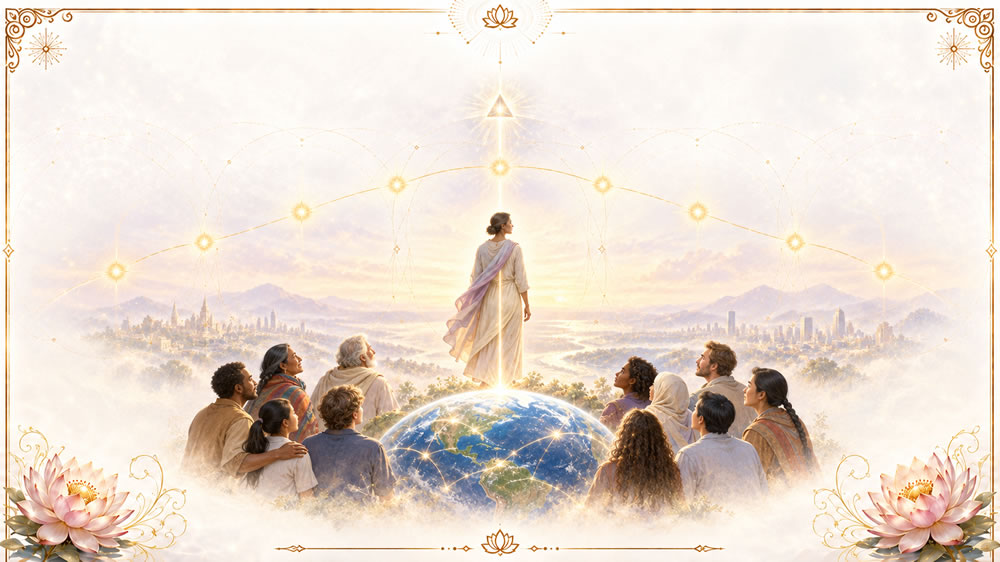
Planetary Light Contemplative Study Module
Featured Text - The Dharma Path of the Initiate
The Planetary Light Contemplative Study is an interactive learning environment designed to support more than the reading of spiritual ideas. It presents each teaching as a guided sequence of study, reflection, and synthesis, allowing the visitor to move through substantial material without being confronted by an overwhelming page of continuous text.
Each study unfolds through a series of related movements. The visitor encounters one principle at a time, considers a reflective question, and pauses with a seed thought before continuing. Optional areas of deeper exploration provide additional understanding without interrupting the main pathway. Those who prefer conventional reading may open the complete article at any time.
This approach recognizes that spiritual knowledge is not fully assimilated through information alone. Understanding develops as an idea is quietly held, examined in relation to life, and gradually brought into meaningful expression. The contemplative study therefore creates space for both intellectual clarity and inward response.
As this environment develops, selected studies may also include spoken teachings, contemplative audio, visual presentations, and other supporting resources. Each element will serve the central purpose of the experience: to help the visitor move from information, through contemplation, toward understanding and living application.
A Planetary Light Contemplative Study
The Dharma Path of the Initiate
Service, Responsibility, and the Way Beyond Transfiguration
1 of 8 —
Threshold
Opening Threshold
The Third Initiation marks a profound turning point upon the Path. Known in the Ageless Wisdom as the Transfiguration, it represents more than spiritual attainment. It signifies the emergence of a life increasingly governed by spiritual purpose and responsibility.
This contemplative study explores that transition through eight movements. Each stage presents one aspect of the initiate’s responsibility and offers a moment for reflection before proceeding.
- 1Transfiguration
- 2Responsibility
- 3Transmission
- 4Harmlessness
- 5Group Service
- 6The Plan
- 7Purpose
- 8Humanity
Stage 1
Transfiguration
From Discipleship to Spiritual Responsibility
Within the Ageless Wisdom, the Third Initiation is known as the Transfiguration. It marks a decisive transition in which the personality becomes increasingly responsive to the Soul and capable of serving as an instrument for spiritual purpose.
The initiate is no longer primarily occupied with purification, personal development, or the establishment of soul contact. These foundations have already been substantially developed. A new question begins to dominate consciousness: not simply What must I become? but What must now be accomplished through this life?
This is why the Third Initiation is regarded as the first of the major initiations. The disciple begins to enter consciously into a wider field of responsibility. Spiritual realization increasingly becomes inseparable from service.
Seed ThoughtGreater light brings greater responsibility.
Stage 2
Responsibility
The Life Becomes Available to the Whole
The Dharma of the initiate may be understood as the responsibility arising from spiritual realization. Dharma is no longer centered mainly upon personal liberation, refinement of character, or individual attainment. These remain important, but they cease to be the central purpose.
The initiate increasingly recognizes life as participation within a greater field—the Ashram, the Hierarchy, humanity, and ultimately the planetary Purpose. Spiritual attainment is therefore not possession. It is availability.
The personality remains a necessary instrument, but it is no longer intended to become the center of the work. Recognition, status, authority, and spiritual identity gradually give way to usefulness. Service becomes less an activity that one performs and more an expression of what consciousness has become.
Seed ThoughtThe initiate does not ask what can be received, but what can be given through the life.
Dharma: At this stage, Dharma may be understood as right participation in the larger spiritual purpose rather than simply personal duty.
Impersonality: Impersonality does not mean coldness. It means loving and serving without making the separated self the center of the activity.
Stage 3
Transmission
Receiving, Transforming, and Distributing Spiritual Energy
Beyond the Third Initiation, the initiate increasingly becomes an agent of transmission. Spiritual energy is no longer contacted solely for illumination or personal realization. It must be received, qualified, transformed, and distributed.
The initiate therefore stands symbolically between higher spiritual centers and humanity. What is contacted at subtler levels must be translated into forms that can safely serve human consciousness.
This responsibility requires discrimination. Spiritual energy cannot simply be released because it has been contacted. Timing, proportion, readiness, and the capacity of the receiving field must all be considered.
The mature server learns when to speak and when silence serves more effectively, when to strengthen an existing form and when to permit an outworn form to pass away.
Seed ThoughtEnergy must be transformed before it can become service.
Impression: Higher impression requires interpretation. The initiate must continually distinguish between true spiritual impression and personal thought, desire, or expectation.
Transformation: The task is not merely to receive force, but to reduce its potency into forms appropriate to human need.
Stage 4
Harmlessness
The Ethical Responsibility of Spiritual Power
As spiritual sensitivity and potency increase, harmlessness assumes a deeper meaning. It is no longer merely the avoidance of physical or emotional injury. It involves responsibility for the consequences of thought, speech, motive, influence, and the use of spiritual force.
The initiate does not seek personal devotion, dependence, or unquestioning obedience. True spiritual service strengthens freedom, intelligence, responsibility, and the awakening of the Soul within others.
Harmlessness therefore becomes inseparable from right human relations. The initiate works wherever separation can give way to understanding, competition to cooperation, fear to goodwill, and selfish appropriation to right circulation.
Spiritual realization must eventually improve the quality of human relationship. Otherwise, it remains incomplete in expression.
Seed ThoughtTrue spiritual influence awakens rather than possesses.
Right Human Relations: These may find expression in family, community, education, economics, governance, religion, science, culture, and every other field of human life.
Stage 5
Group Service
From Individual Effort to Shared Spiritual Purpose
Initiatory consciousness is inherently group conscious. As the disciple advances, service becomes progressively less centered upon isolated individual activity and more closely related to a larger field of spiritual cooperation.
The initiate learns to strengthen group coherence without controlling the group. Diversity of temperament, Ray quality, background, and function is not necessarily an obstacle. Properly understood, diversity can become a means through which a richer expression of spiritual purpose emerges.
The initiate therefore learns to preserve unity without demanding uniformity. Personal preferences are subordinated to the larger purpose of the work.
The group becomes not merely a collection of people but a field through which spiritual energy can be received and distributed with greater safety and effectiveness.
Seed ThoughtThe group becomes strong when purpose is shared and individuality is rightly related.
Ashramic Consciousness: The Ashram may be understood as a field of spiritual relationship and service rather than simply a collection of individual disciples.
Group Responsibility: The initiate increasingly thinks in terms of what strengthens the whole field rather than what advances personal position.
Stage 6
The Plan
Bringing Spiritual Principles into Living Form
The initiate does not remain satisfied with contemplation of spiritual ideas. Spiritual principles must ultimately be translated into forms capable of enriching human life.
This is the precipitation of the Plan.
Ideas must become relationships, educational methods, communities, institutions, systems of cooperation, cultural expressions, and practical acts of service. The initiate becomes a bridge between spiritual reality and human necessity.
For this reason, good intention alone is insufficient. Spiritual intelligence must be accompanied by an understanding of humanity as it actually exists.
Science, psychology, culture, economics, education, governance, technology, religion, and social organization all become legitimate fields of observation and service. The initiate seeks to recognize where consciousness is attempting to advance and how emerging spiritual principles can be responsibly expressed.
Seed ThoughtThe Plan is fulfilled when spiritual principle becomes useful human expression.
From Idea to Form: A spiritual idea becomes effective only when it can be translated into a form appropriate to time, place, culture, and human readiness.
Discrimination: Not every old form must be destroyed, nor every new form adopted. The initiate learns to recognize what continues to serve the evolving Life.
Stage 7
Purpose
Will, Timing, Sacrifice, and the Greater Direction
Beyond the Transfiguration, the initiate begins gradually to respond to a deeper dimension of spiritual Will. The relationship to the Soul and the Hierarchy expands toward an emerging sensitivity to Purpose.
Purpose is not personal intention amplified by spiritual aspiration. It is the deeper direction underlying the evolutionary movement of the Whole.
The initiate therefore learns something of spiritual timing. There are moments for construction and moments for dissolution, times for speech and times for silence, times for outward activity and times for inward preparation.
Sacrifice also assumes a new meaning. It is no longer merely the surrender of personal desire. It becomes the willingness to release even cherished forms of service when they no longer adequately express the emerging purpose.
The initiate remains unattached to the form because loyalty belongs ultimately to the Life the form was created to serve.
Seed ThoughtThe initiate serves the Life behind the form.
Spiritual Will: Will is not forcefulness or domination. In its higher expression, it is steadfast alignment with perceived spiritual purpose.
Timing: Truth presented at the wrong time or in an unsuitable form may fail to serve. Timing becomes part of the science of service.
Stage 8
Humanity
The Field of Initiatory Service
The Path beyond the Third Initiation does not lead away from humanity. It leads more deeply into responsibility for humanity.
The initiate increasingly perceives humanity not primarily through its failures, conflicts, or limitations, but through its immense spiritual potential. Humanity is the field within which intelligence, love, creativity, freedom, and conscious cooperation are progressively developing.
The Hierarchy, in the Ageless Wisdom presentation, does not exist as an escape from the human condition. It serves the evolutionary emergence of consciousness within the human family.
The initiate therefore becomes increasingly available to that purpose. Freedom from personal compulsion produces greater capacity for service. The less the separated self dominates consciousness, the more freely the life can become an instrument for the Whole.
At deeper levels, the initiate stands within a great movement of impression, reception, transformation, and transmission. Spiritual energies are received, interpreted, stepped down, and eventually expressed as intelligent and compassionate activity within the world.
The Dharma Path therefore culminates not in spiritual privilege but in spiritual availability.
Seed ThoughtThe greater the liberation from the separated self, the greater the capacity to serve the Whole.
Synthesis
The Dharma of the Transfigured Disciple
The initiate seeks to know the Plan as far as it can be known, to align with Purpose as far as it can be sensed, and to translate both into intelligent, loving, practical service.
This is not attainment for its own sake. It is increasing availability to the One Life.
Closing Contemplation
Receive the Light.
Embody the Love.
Wield the Will with Wisdom.
Serve the Human Family.
The Path beyond Transfiguration is the Path of conscious responsibility: to receive the Light, embody the Love, wield the Will with wisdom, and place all three at the service of the human family.
Opening Threshold
The Third Initiation marks a profound turning point upon the Path. Known in the Ageless Wisdom as the Transfiguration, it represents more than spiritual attainment. It signifies the emergence of a life increasingly governed by spiritual purpose and responsibility.
This contemplative study explores that transition through eight movements. Each stage presents one aspect of the initiate’s responsibility and offers a moment for reflection before proceeding.
Stage 1
Transfiguration
From Discipleship to Spiritual Responsibility
Within the Ageless Wisdom, the Third Initiation is known as the Transfiguration. It marks a decisive transition in which the personality becomes increasingly responsive to the Soul and capable of serving as an instrument for spiritual purpose.
The initiate is no longer primarily occupied with purification, personal development, or the establishment of soul contact. These foundations have already been substantially developed. A new question begins to dominate consciousness: not simply What must I become? but What must now be accomplished through this life?
This is why the Third Initiation is regarded as the first of the major initiations. The disciple begins to enter consciously into a wider field of responsibility. Spiritual realization increasingly becomes inseparable from service.
Seed ThoughtGreater light brings greater responsibility.
Stage 2
Responsibility
The Life Becomes Available to the Whole
The Dharma of the initiate may be understood as the responsibility arising from spiritual realization. Dharma is no longer centered mainly upon personal liberation, refinement of character, or individual attainment. These remain important, but they cease to be the central purpose.
The initiate increasingly recognizes life as participation within a greater field—the Ashram, the Hierarchy, humanity, and ultimately the planetary Purpose. Spiritual attainment is therefore not possession. It is availability.
The personality remains a necessary instrument, but it is no longer intended to become the center of the work. Recognition, status, authority, and spiritual identity gradually give way to usefulness. Service becomes less an activity that one performs and more an expression of what consciousness has become.
Seed ThoughtThe initiate does not ask what can be received, but what can be given through the life.
Explore Further
Dharma: At this stage, Dharma may be understood as right participation in the larger spiritual purpose rather than simply personal duty.
Impersonality: Impersonality does not mean coldness. It means loving and serving without making the separated self the center of the activity.
Stage 3
Transmission
Receiving, Transforming, and Distributing Spiritual Energy
Beyond the Third Initiation, the initiate increasingly becomes an agent of transmission. Spiritual energy is no longer contacted solely for illumination or personal realization. It must be received, qualified, transformed, and distributed.
The initiate therefore stands symbolically between higher spiritual centers and humanity. What is contacted at subtler levels must be translated into forms that can safely serve human consciousness.
This responsibility requires discrimination. Spiritual energy cannot simply be released because it has been contacted. Timing, proportion, readiness, and the capacity of the receiving field must all be considered.
The mature server learns when to speak and when silence serves more effectively, when to strengthen an existing form and when to permit an outworn form to pass away.
Seed ThoughtEnergy must be transformed before it can become service.
Explore Further
Impression: Higher impression requires interpretation. The initiate must continually distinguish between true spiritual impression and personal thought, desire, or expectation.
Transformation: The task is not merely to receive force, but to reduce its potency into forms appropriate to human need.
Stage 4
Harmlessness
The Ethical Responsibility of Spiritual Power
As spiritual sensitivity and potency increase, harmlessness assumes a deeper meaning. It is no longer merely the avoidance of physical or emotional injury. It involves responsibility for the consequences of thought, speech, motive, influence, and the use of spiritual force.
The initiate does not seek personal devotion, dependence, or unquestioning obedience. True spiritual service strengthens freedom, intelligence, responsibility, and the awakening of the Soul within others.
Harmlessness therefore becomes inseparable from right human relations. The initiate works wherever separation can give way to understanding, competition to cooperation, fear to goodwill, and selfish appropriation to right circulation.
Spiritual realization must eventually improve the quality of human relationship. Otherwise, it remains incomplete in expression.
Seed ThoughtTrue spiritual influence awakens rather than possesses.
Explore Further
Right Human Relations: These may find expression in family, community, education, economics, governance, religion, science, culture, and every other field of human life.
Stage 5
Group Service
From Individual Effort to Shared Spiritual Purpose
Initiatory consciousness is inherently group conscious. As the disciple advances, service becomes progressively less centered upon isolated individual activity and more closely related to a larger field of spiritual cooperation.
The initiate learns to strengthen group coherence without controlling the group. Diversity of temperament, Ray quality, background, and function is not necessarily an obstacle. Properly understood, diversity can become a means through which a richer expression of spiritual purpose emerges.
The initiate therefore learns to preserve unity without demanding uniformity. Personal preferences are subordinated to the larger purpose of the work.
The group becomes not merely a collection of people but a field through which spiritual energy can be received and distributed with greater safety and effectiveness.
Seed ThoughtThe group becomes strong when purpose is shared and individuality is rightly related.
Explore Further
Ashramic Consciousness: The Ashram may be understood as a field of spiritual relationship and service rather than simply a collection of individual disciples.
Group Responsibility: The initiate increasingly thinks in terms of what strengthens the whole field rather than what advances personal position.
Stage 6
The Plan
Bringing Spiritual Principles into Living Form
The initiate does not remain satisfied with contemplation of spiritual ideas. Spiritual principles must ultimately be translated into forms capable of enriching human life.
This is the precipitation of the Plan.
Ideas must become relationships, educational methods, communities, institutions, systems of cooperation, cultural expressions, and practical acts of service. The initiate becomes a bridge between spiritual reality and human necessity.
For this reason, good intention alone is insufficient. Spiritual intelligence must be accompanied by an understanding of humanity as it actually exists.
Science, psychology, culture, economics, education, governance, technology, religion, and social organization all become legitimate fields of observation and service. The initiate seeks to recognize where consciousness is attempting to advance and how emerging spiritual principles can be responsibly expressed.
Seed ThoughtThe Plan is fulfilled when spiritual principle becomes useful human expression.
Explore Further
From Idea to Form: A spiritual idea becomes effective only when it can be translated into a form appropriate to time, place, culture, and human readiness.
Discrimination: Not every old form must be destroyed, nor every new form adopted. The initiate learns to recognize what continues to serve the evolving Life.
Stage 7
Purpose
Will, Timing, Sacrifice, and the Greater Direction
Beyond the Transfiguration, the initiate begins gradually to respond to a deeper dimension of spiritual Will. The relationship to the Soul and the Hierarchy expands toward an emerging sensitivity to Purpose.
Purpose is not personal intention amplified by spiritual aspiration. It is the deeper direction underlying the evolutionary movement of the Whole.
The initiate therefore learns something of spiritual timing. There are moments for construction and moments for dissolution, times for speech and times for silence, times for outward activity and times for inward preparation.
Sacrifice also assumes a new meaning. It is no longer merely the surrender of personal desire. It becomes the willingness to release even cherished forms of service when they no longer adequately express the emerging purpose.
The initiate remains unattached to the form because loyalty belongs ultimately to the Life the form was created to serve.
Seed ThoughtThe initiate serves the Life behind the form.
Explore Further
Spiritual Will: Will is not forcefulness or domination. In its higher expression, it is steadfast alignment with perceived spiritual purpose.
Timing: Truth presented at the wrong time or in an unsuitable form may fail to serve. Timing becomes part of the science of service.
Stage 8
Humanity
The Field of Initiatory Service
The Path beyond the Third Initiation does not lead away from humanity. It leads more deeply into responsibility for humanity.
The initiate increasingly perceives humanity not primarily through its failures, conflicts, or limitations, but through its immense spiritual potential. Humanity is the field within which intelligence, love, creativity, freedom, and conscious cooperation are progressively developing.
The Hierarchy, in the Ageless Wisdom presentation, does not exist as an escape from the human condition. It serves the evolutionary emergence of consciousness within the human family.
The initiate therefore becomes increasingly available to that purpose. Freedom from personal compulsion produces greater capacity for service. The less the separated self dominates consciousness, the more freely the life can become an instrument for the Whole.
At deeper levels, the initiate stands within a great movement of impression, reception, transformation, and transmission. Spiritual energies are received, interpreted, stepped down, and eventually expressed as intelligent and compassionate activity within the world.
The Dharma Path therefore culminates not in spiritual privilege but in spiritual availability.
Seed ThoughtThe greater the liberation from the separated self, the greater the capacity to serve the Whole.
The Dharma of the Transfigured Disciple
The initiate seeks to know the Plan as far as it can be known, to align with Purpose as far as it can be sensed, and to translate both into intelligent, loving, practical service.
This is not attainment for its own sake. It is increasing availability to the One Life.
Closing Contemplation
Receive the Light.
Embody the Love.
Wield the Will with Wisdom.
Serve the Human Family.
The Path beyond Transfiguration is the Path of conscious responsibility: to receive the Light, embody the Love, wield the Will with wisdom, and place all three at the service of the human family.