

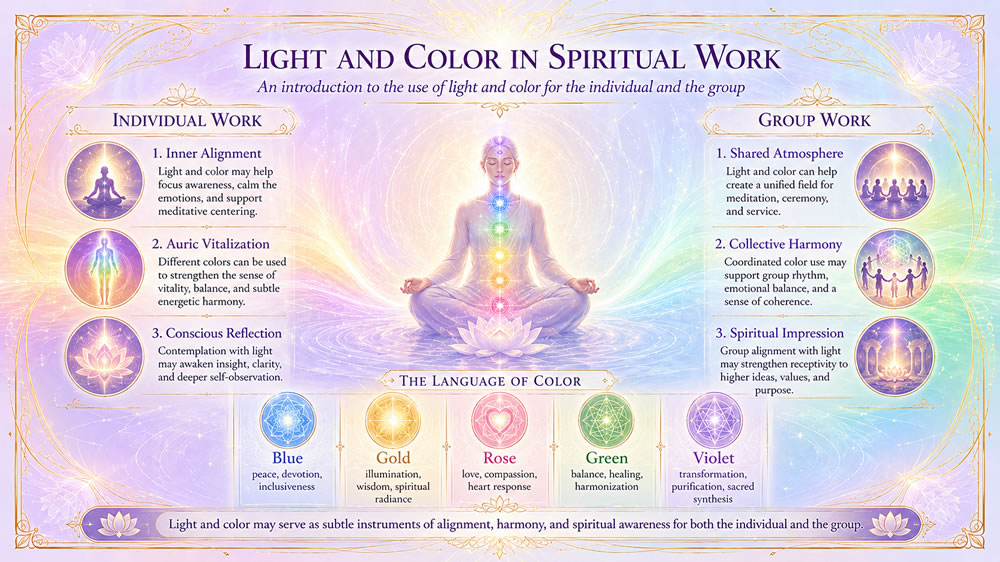
Light and Color: Healing, Regulation, and Expanded Awareness
Working with Illumination as a Physical, Psychological, and Contemplative Influence
Light is one of the most fundamental influences upon human biology and consciousness. At the physical level, exposure to light helps regulate circadian rhythms, sleep, wake cycles, alertness, hormone timing, and mood through pathways involving the eyes and brain. The most established therapeutic uses of light are therefore those that work with these biological systems: appropriately timed bright-light exposure for certain sleep and circadian disturbances, controlled phototherapy for specific medical conditions, and carefully managed exposure to natural daylight. In this context, light is not treated as an abstract spiritual force, but as a measurable environmental stimulus capable of producing real physiological effects when intensity, wavelength, duration, and timing are properly considered.
Different wavelengths of light interact with the body in different ways. Blue-rich light has a particularly strong influence on circadian signaling and daytime alertness, which is why morning daylight can help establish a healthy daily rhythm; excessive bright or blue-rich light late at night, however, can interfere with sleep. Red and near-infrared light are also being studied and used in forms of photobiomodulation, where specific wavelengths are applied to tissue under controlled conditions. Research suggests possible benefits in some areas of wound healing, pain, inflammation, and tissue recovery, although effects depend greatly upon wavelength, dose, treatment method, and the condition being addressed. Such applications are best understood as emerging or condition-specific therapies rather than as evidence that any particular color possesses a universal healing property.
Color also influences human experience through perception and psychology. The colors surrounding us can affect attention, comfort, emotional tone, perceived warmth, spaciousness, and levels of stimulation. These responses are partly physiological, partly psychological, and strongly shaped by culture, memory, personal association, and context. For this reason, color can be used constructively in meditation rooms, healing environments, homes, and contemplative spaces, not because a single color automatically produces a predetermined result, but because the visual environment can help establish conditions supportive of relaxation, concentration, vitality, or inward reflection.
Within contemplative practice, color may also serve as a focus of consciousness. A practitioner might gently visualize a field of blue, gold, violet, green, or white light while maintaining relaxed breathing and sustained attention. The value of such an exercise lies primarily in the organization of attention, imagination, emotional response, and intention. When practiced without strain, color visualization can become a means of quieting mental activity and deepening concentration. Experiences of spaciousness, luminosity, inner imagery, or altered perception may arise during meditation, but these should be approached as subjective states of consciousness rather than as proof that a particular wavelength or imagined color has produced a specific esoteric or medical effect.
A particularly useful approach is to bring together light, breath, sound, and awareness without confusing their different functions. Soft environmental illumination can establish the outer atmosphere; rhythmic breathing can stabilize attention and autonomic arousal; vocal toning or gentle sound can introduce felt vibration; and visualization can provide an inner field of symbolic color. Used together, these elements may create a highly coherent contemplative experience in which the body relaxes, attention becomes more unified, and subtle sensations become easier to perceive. The purpose need not be to force an extraordinary state, but to establish sufficient stillness and coherence for deeper awareness to emerge naturally.
The most responsible use of light and color therefore combines discernment with experimentation. Physical light therapies should be matched to established methods and, where medical conditions are involved, appropriate professional guidance. Decorative and environmental color can be explored according to individual response, while visualization and colored-light meditation can be used as contemplative disciplines rather than presented as proven cures. For the student of consciousness, this distinction is important: light may act biologically, color may influence perception and emotion, and imagined luminosity may become a powerful symbol within meditation. When these levels are clearly understood, light and color can be approached not as magical remedies, but as meaningful tools for regulation, reflection, healing environments, and the exploration of consciousness.