
Introduction to the Study of Analog and Digital Sound
Please note: Sound is a complex interplay of vibrations, frequencies, and waveforms that interact with matter and space in precise and dynamic ways. Understanding the technical complexities of sound, such as frequency, resonance, harmonics, and waveform, enables more precise and effective use of sound for healing and expanded states of consciousness. This knowledge helps practitioners select tones that align with specific energy centers, induce brainwave entrainment, and create vibrational environments that support physical balance, emotional release, and spiritual awakening.
Sound, at its core, is the vibration of air particles that travel in waves and is perceived by the human body (cymatics). The study of sound, particularly in the fields of audio engineering, music production, and telecommunications, often involves understanding how sound can be captured, stored, and reproduced. This leads to the two main categories of sound representation: analog and digital.
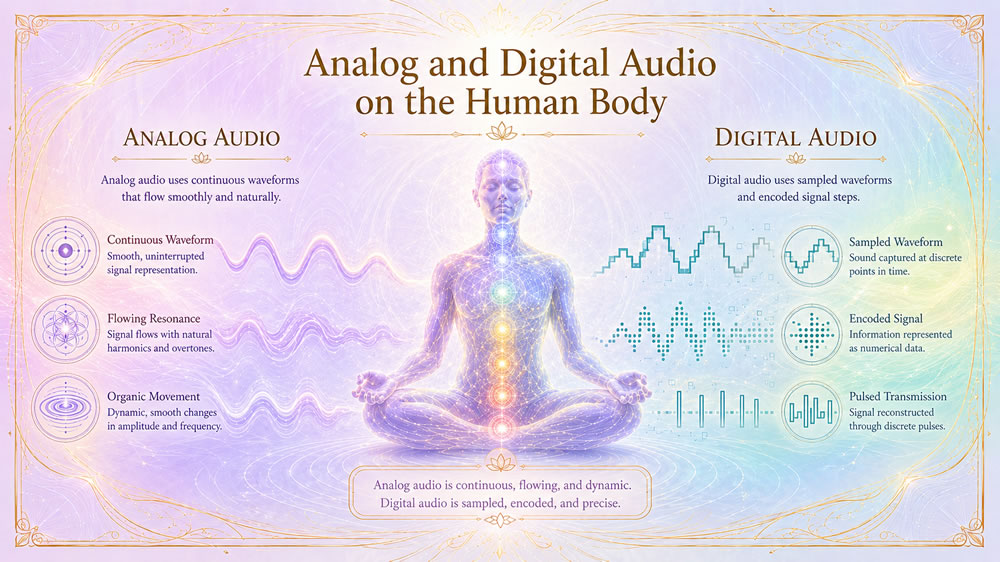
It is important for us to understand the dynamics of how the body responds to each of these formats. We begin our exploration into sound by examining these two aspects when listening to sound/music.
When comparing analog waves to digital compression, we're looking at two fundamentally different ways of representing sound. Here’s a breakdown of how they differ:
1. Nature of the Signal: Analog vs. Digital
- Analog Waves:
- Analog sound is a continuous waveform that directly mirrors the vibrations in the air (or any physical sound source). It’s continuous and doesn’t have discrete steps. The sound is represented by a smooth wave that fluctuates without interruption.
- Example: The sound of a vinyl record or a tape recording. The signal’s strength can vary infinitely within the limits of the medium.
- Digital Compression:
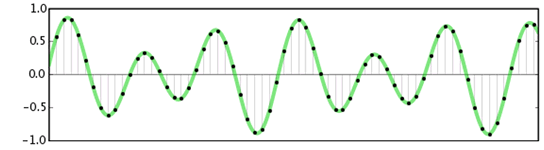
- Digital sound, on the other hand, represents sound in a series of discrete samples. The audio is broken down into snapshots of data at specific intervals (sample rate), and each sample is then quantized (converted into a number, typically at a fixed bit depth).
- Compression: Digital compression involves reducing the size of these samples by removing some of the audio information that’s less likely to be perceived by the human ear. Common formats like MP3 or AAC reduce file sizes by eliminating high-frequency sounds and other less audible details.
Analog
Analog audio refers to sound recorded and reproduced using continuous electrical signals that directly correspond to the original sound waves. Unlike digital audio, which breaks sound into binary code, analog preserves the natural waveforms, resulting in a warm, rich quality often prized by audiophiles. Common analog formats include vinyl records and magnetic tape, which capture the nuances of sound in a more fluid, organic way.
Audio pressure waves, or waveforms, look something like this: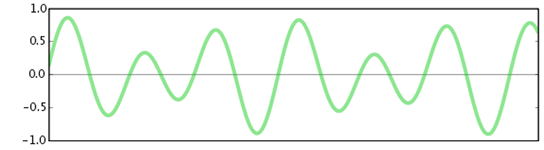
Digital
Digital recording works differently: it samples the waveform at evenly spaced timepoints, representing each sample as a precise number. Digital recordings, whether stored on a compact disc (CD), digital audio tape (DAT), or on a personal computer, do not degrade over time and can be copied perfectly without introducing any additional noise. The following image illustrates a sampled (digital) audio waveform: