

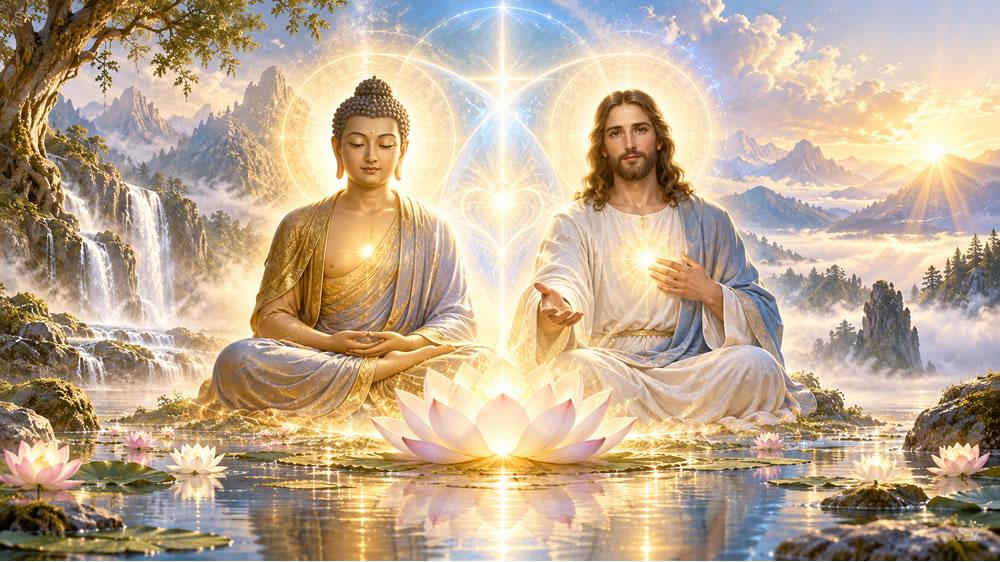
The Steps to Liberation from the Three Worlds
The Tibetan indicates that liberation becomes possible when the disciple unites the illumined understanding of the Buddha with the radiatory love of the Christ. These two divine currents, light and love, when fused within the consciousness, produce the wisdom-of-the-soul, which alone can disentangle the disciple from the glamours, illusions, and material attachments inherent in the three worlds. The Buddha’s revelation of the Causes of Suffering and the Middle Way clears the mind; the Christ’s revelation of Love as the Law of Life opens the heart. When both energies work simultaneously, the personality yields its separativeness, and the soul assumes control.
The first step in this blended approach is the cultivation of discrimination and dispassion, the essential gifts of the Buddha. Through sustained mental poise, meditative clarity, and the steady unveiling of illusion, the disciple learns to recognize the causes that bind them to desire, form, and cyclic repetition. Without this discriminative faculty, the love-energy of the Christ cannot be expressed wisely, for love without illumination becomes sentiment, and illumination without love becomes austerity. The Buddha anchors the mind in truth, freeing it from the distortions that arise within the lower self.
The second step is the awakening of inclusive love, the hallmark of the Christ. When the heart becomes a radiatory center of harmlessness and goodwill, the disciple no longer relates to life through the personality’s demands but through the soul’s capacity for selfless service. The Christ principle dissolves the sense of separation, replacing the personal will with the will-to-good. This results in a reorientation from the small self toward the greater whole, generating the magnetic field required for group work and group initiation. Love becomes the agent of fusion.
The third step is the establishment of right spiritual tension, arising from the fusion of Buddha’s illumination and Christ’s love within the disciple’s integrated personality. This tension draws the energies of the Triad downward, lifting the consciousness upward, and producing the “point of release” described by the Tibetan. At this stage, the disciple lives increasingly from the buddhic plane, where dualities are reconciled and where the path of liberation opens. The three worlds lose their compelling force because the disciple has anchored his consciousness in a higher vibratory field.
The final step is the act of relinquishment, the clear decision to stand free from identification with the lower vehicles. This is not escape but transcendence, achieved through service, sacrifice, and steadfast alignment. When illumination reveals the unreal and love anchors the real, the disciple steps through the door of liberation as one who has “died to the personal life and risen into the Life more abundant.” Thus, the blended teachings of Buddha and Christ become not merely complementary but initiatory, the two pillars forming the gateway through which the disciple passes into the freedom of the Kingdom of Souls.